

Inoculation Station
Chuan Tsai, Ran Xu, Jerome Huang, Laurel Fang, Sophia Collender
This project speculates a future biotechnology system that transforms the spotted lanternfly (SLF), an invasive agricultural pest, into a biological carrier for plant health. Drawing on the natural ability of Beauveria bassiana to infect SLFs and establish beneficial relationships with plants, we propose an inoculation station that deliberately infects lanternflies and repurposes them as temporary agents of fungal distribution. Rather than eliminating the species outright, the system allows SLFs to circulate through vineyards before dying from infection several days later. Through this speculative scenario, the project questions how value, legality, and belonging are assigned to living organisms. It asks what changes when an organism shifts from being classified as a threat to becoming a useful component within an engineered ecological infrastructure.

Problem


Spotted Lanternfly is an invasive insect that has rapidly spread across the American Northeast. It is originally from Southeast Asia, primarily China, India, and Vietnam, and was first detected in Pennsylvania in 2014 and has since spread to 18 states.


Spotted lanternflies have caused massive agricultural and commercial damage with their spread through the United States. It mainly feeds on the sap of plants like grapevines and fruit trees, which are critical to agriculture. As it feeds, it leaves behind a sugary residue that promotes mold growth, ultimately damaging or even killing the plant. So essentially, it disrupts both plant health and the larger agricultural economy.
Research
Predictable Life Cycle

Sep-May
May-Aug
Aug-Dec
Spotted lanternfly completes one generation per year. The life cycle consists of three main stages: overwintering eggs, the nymph, and the adult stage.
Adult females lay eggs on almost any flat surface. These eggs can survive through winter and hatch during spring. In July, the nymphs start turning red and grow to about a half-inch long. They transform into winged adults around late July to August. Adults feed on the woody parts of trees, mate, and lay eggs throughout the fall until the first hard freeze kills them.
Natural Behavior


Blown to ground
Walk to base of the tree
Climb up back the trunk
If they are blown to ground from trees by wind or rain, instead of flying back, SLFs tend to return to the base of the trunk and crawl upward again. This repetitive climbing behavior is highly predictable and has already been widely utilized in existing pest management strategies.
Current Solutions
Physical Removal

Environmental Management

Chemical Treatments
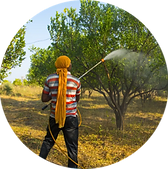
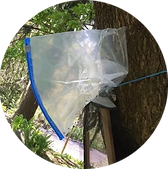
Current methods for controlling spotted lanternflies rely primarily on physical removal, chemical treatments, and environmental management.
Mechanical strategies include scraping egg masses during the winter, installing sticky bands or circle traps on tree trunks, and manually removing insects. Chemical control methods involve the use of contact insecticide. Environmental strategies, such as removing preferred host trees like Tree of Heaven (Ailanthus altissima), can help reduce SLF populations but require significant effort and coordination.
However, these existing solutions of eliminating SLFs are often limited in effectiveness, scalability, or ecological impact.
Natural Enemies


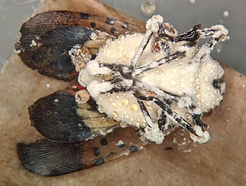
Researchers have observed that several species — including birds, bats, and fungi such as Beauveria bassiana — can interact with or prey on SLFs.
From a research in New Jersey, scientists discovered that bats are actively consuming spotted lanternflies. By analyzing bat poop, researchers identified SLF remains in their diet, suggesting that local bat populations may already be adapting to the presence of this invasive species. Researchers have also observed that some bird species have started feeding on spotted lanternflies, despite the insect originally having relatively few predators in the United States. At the same time, fungi such as B.bassiana naturally infect and kill SLFs within several days after contact.
Beauveria Bassiana

As Biopesticide
-
Contact-acting fungus that infects through brief exposure
-
Causing death in 3-7 days
-
EPA-registered biological insecticide
-
Eco-friendly & Resistance prevention
As Endophyte

Defence drought stress

Enhance plant immunity

Promote plant growth
What makes B.bassiana especially interesting for our project is that it is not only used as a biopesticide, but can also function as an endophyte — a fungus capable of living inside plant tissues without harming the plant.
Previous studies suggest that endophytic B. bassiana can promote plant growth, improve tolerance to environmental stress such as drought, and enhance plant immune responses. In some cases, it has also been associated with reduced insect infestation and improved overall plant health.
Design
Dead
Device Design


+
=


3-7 days
SLF infected with B. bassiana
Our proposal is to build an “Inoculation Station” installed directly onto vineyard tree trunks. Instead of functioning purely as a trap, the device guides SLFs through a controlled passage coated with fungal material. As the insects crawl through the structure, they become exposed to B. bassiana spores through physical contact.
During the several days before death, infected SLFs continue their normal feeding and climbing behavior throughout the vineyard. In our speculative system, this turns them into temporary biological carriers capable of distributing fungal material between plants through repeated contact.
An important aspect of this system is that the insects are still expected to die after infection, meaning the project does not rely on maintaining future generations of infected SLFs. Instead, it exploits a short biological window that already exists in nature.
Bio-material
To simplify and safely prototype the transfer system, we used several controllable material functions rather than working directly with live fungal spores.

First, we used UV fluorescent powder as a visual tracer. Instead of representing the exact biology of Beauveria bassiana, it allows us to visually track transfer under UV light and estimate how much material can be carried through a single contact event.
For the carrier system, we used triethyl citrate, an oil-based liquid commonly associated with spore stabilization and wetting. Previous studies suggest that oil-based carriers can improve adhesion to insect cuticles and extend spore viability under environmental stress.


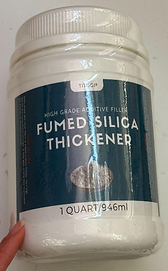
To transform the liquid into a more controllable coating, we incorporated fumed silica as a thickening agent. This creates a gel-like material that can remain on the device surface without immediately dripping away.
Finally, because we were not working with live spotted lanternflies, we used fly lures as physical stand-ins. Their fuzzy surface and lightweight structure allowed us to roughly simulate insect contact and evaluate whether material transfer could occur through physical interaction.
Required Concentration

Insect infestation reduction across different nutrient conditions

Plant growth & productivity
Previous studies using strawberry hydroponic systems showed that when B.bassiana was inoculated at a concentration of 1 × 10⁸ conidia/mL, researchers observed multiple effects, including reduced insect infestation and changes related to plant growth and productivity.
Inoculation Station
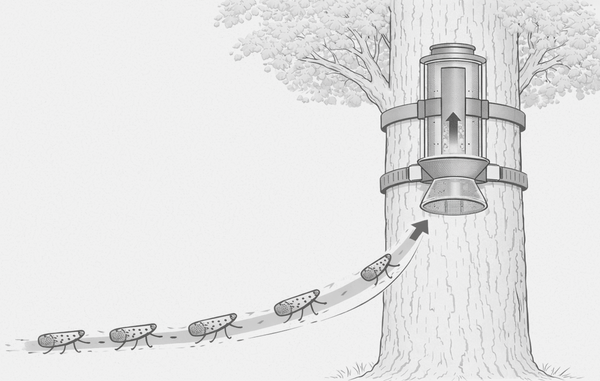
Inoculation Station is a physical desisgn for farmers and is able to be easily installed on the trunks of grape vines.


While designing the station, we used a modular design to make the entire station easier to maintain.


The inner structure of the station is vertically placed and should be able to hold the biomaterial we made. While design, we gain the inspiration from elote, a Mexican street food. The structure of the corn helps to hold the sauce in place, so we found it a good example for our inner part design.
Future Vineyard Applications
Spider mite on grapes

Mealybugs on grapes
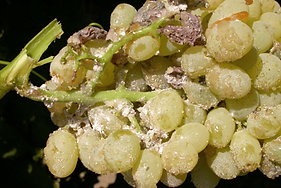

We also hope that the applications extend beyond spotted lanternflies alone. Not only can it solve the SLF problem but it can also serve as a biological control agent for multiple vineyard-associated pests.
One example is spider mites, which damage leaves and reduce photosynthetic capacity. Interestingly, a strawberry hydroponic study we referenced later already observed reduced spider mite infestation in strawberries treated with B. bassiana.
Another important example is mealybugs. These insects feed on plant sap, produce honeydew that promotes sooty mold growth, just like SLFs. But what's worse is they can transmit grapevine viruses. Previous studies have explored B. bassiana as a possible biological control method against mealybugs and related sap-feeding insects.
This became interesting to us because it suggests that our design may not only interact with spotted lanternflies, but have potential in reshaping broader relationships between fungal systems, insects, and vineyard ecology.


